FOREST · PEOPLE · RESIN
A Crimson Gift from the Rainforest
The Tribal Memory Behind Dragon's Blood Resin
— The People and Resin of Sumatra and Kalimantan —
A story about who entered the forest first
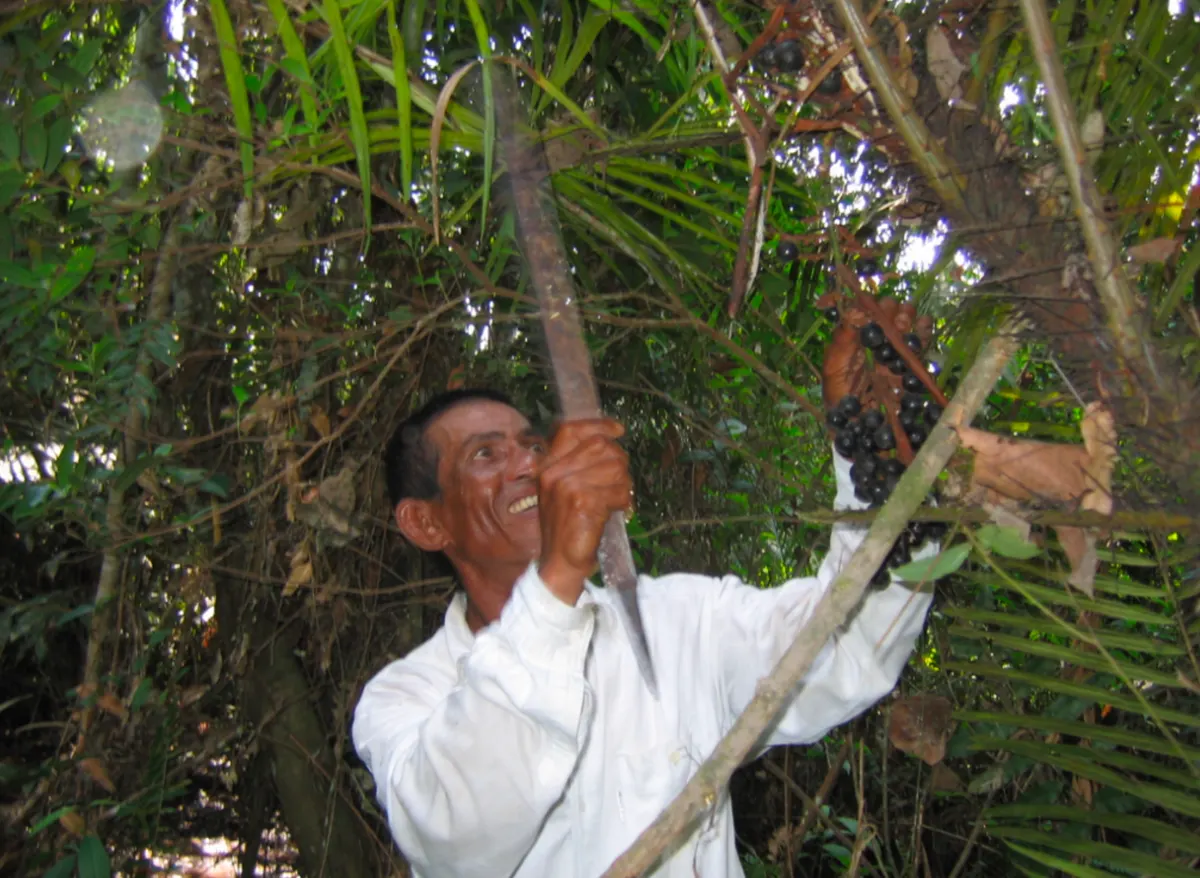
When a buyer in Indonesia purchases a kilogram of dragon's blood resin (jernang), the product comes with an SNI 8663:2018 national standard certificate — moisture content, melting point, resin percentage, ash content, each precisely measured.
But what that certificate won't tell you is this — who was the first to walk into that forest.
Long before this resin was assigned a standard, a price, or a scientific name, it already had its people. Several peoples, in fact — scattered across the rainforests of Sumatra and Kalimantan, each giving the plant their own name, each passing down their own rituals of harvest, each understanding in their own way what a person owes the forest after receiving its gifts.
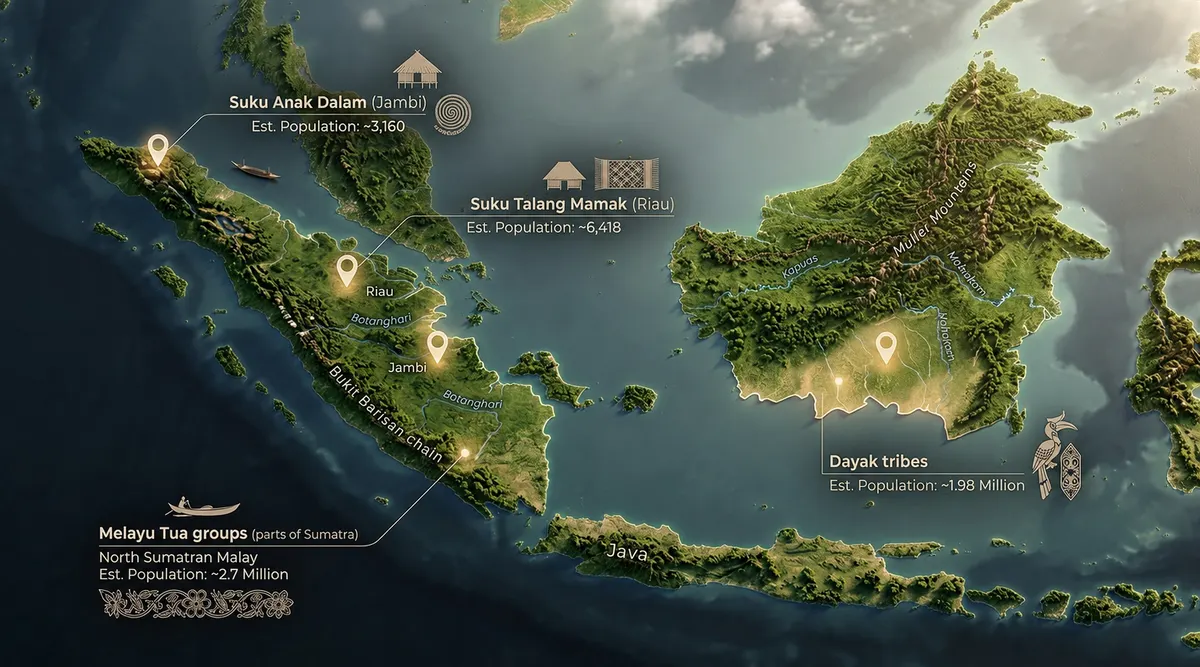
This article isn't about the chemistry of dragon's blood. It's about the layer of people beneath the commodity label — the Suku Anak Dalam of Jambi Province, the Talang Mamak of Riau, the Suku Kubu, the Melayu Tua, and the Dayak peoples of Kalimantan. Before the world had ever heard of jernang, these were the people who shaped it.
For buyers and traders, understanding this layer isn't a matter of romance — it's deeply practical. The quality of dragon's blood resin — its dracorhodin content, harvest timing, resin purity — depends entirely on who harvests it and how they do it. And the people who know the forest best have always been the ones who live inside it.
CHAPTER 01
Who Are the People Behind Dragon's Blood Resin?
01 / The "Children of the Forest" in Jambi
— Suku Anak Dalam (SAD)
Of all the peoples connected to dragon's blood resin, none share a deeper bond with it than the Suku Anak Dalam — a name that means "Children of the Forest." They live in the lowland forests of Jambi Province, primarily around Bukit Dua Belas National Park and Tebo Regency.
Historically, the SAD have also been called Orang Rimba ("People of the Jungle"), and in earlier colonial records, Orang Kubu. They are one of the last semi-nomadic forest peoples remaining on the island of Sumatra. For centuries, they have refused to settle — choosing instead to migrate with the seasons through the forest rather than clear it for farmland. This way of life kept them in the deepest, most intact heart of Sumatra's forests — which happens to be exactly where wild dragon's blood rattan (Daemonorops draco) still survives today.
A Living Forest Encyclopedia
A 2021 study published in Farmasains documented that in Muara Kilis village, Tebo Regency, the SAD community can clearly distinguish between at least two local species — jernang kuau (Daemonorops draco Willd. Blume) and jernang kelukup (Daemonorops sp.).
These are not different names for the same plant. In their eyes, they are two different living things: different fruit shapes, different resin yields, different preferences for forest conditions.
This kind of species-level identification is ethnobotanical knowledge that most modern buyers have never encountered. For the SAD, telling kuau from kelukup is as fundamental as a seasoned tea merchant distinguishing Assam from Darjeeling.
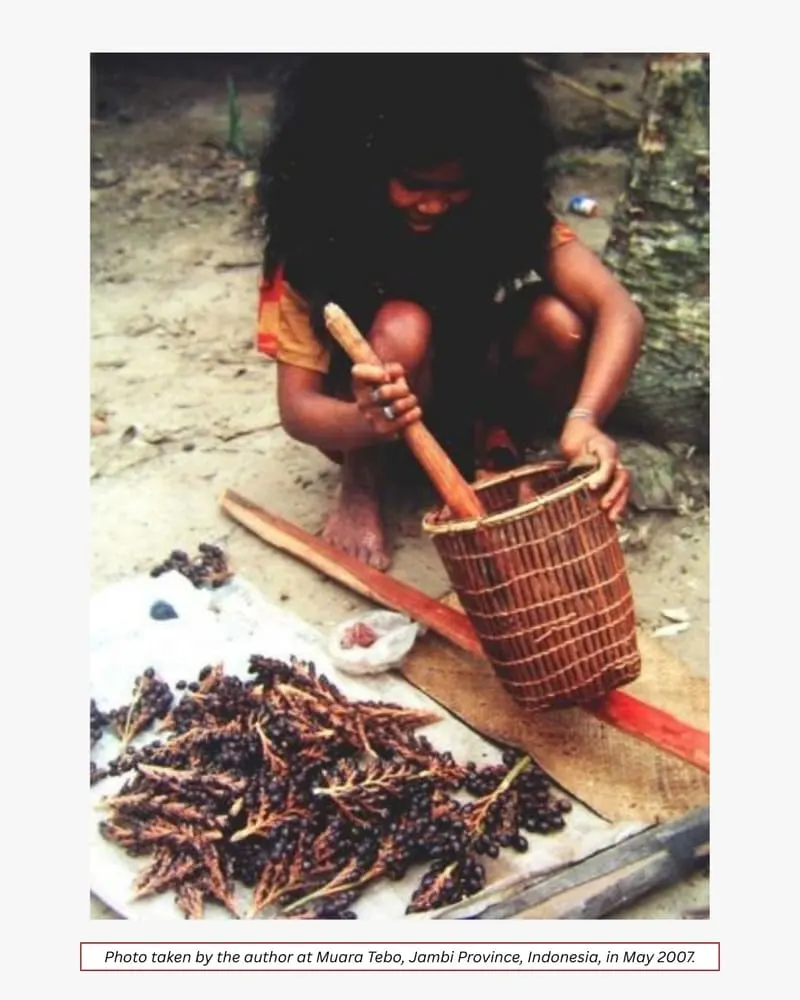
The traditional processing methods within SAD villages are equally distinctive: they pound the fresh rattan fruits by hand, coaxing the resin layer from the outer skin of the fruit, then collecting and processing it. It's a gentle method — done well, it preserves the quality of active compounds far better than the aggressive high-heat extraction used in industrial settings.
The most critical point is this: the SAD are still practicing something we'd only recently think to give a name — "conservation by
habit.
Because they are semi-nomadic and migrate through vast stretches of forest with the seasons, they naturally avoid harvesting the same stands of plants year after year. The forest has time to recover. This kind of "sustainable rotational harvesting" — not an environmental policy, but an ancestral habit of forest use — is precisely what has kept wild jernang populations alive.
02 / Guardians of the Thirty Hills Forest
— The Talang Mamak of Riau and Jambi
Another people with deep ties to dragon's blood resin are the Talang Mamak. They live near Bukit Tigapuluh National Park, straddling the border of Riau and Jambi provinces.
A 2019 report by Mongabay Indonesia documented that when the men of the Talang Mamak enter the forest, they aren't looking only for dragon's blood resin — they also gather rattan, kelukup, various fruits, and kemenyan (benzoin resin). Dragon's blood resin isn't a specialized harvest — it's a regular part of their forest economy.
What makes the Talang Mamak's relationship with dragon's blood resin especially distinctive is its gendered division of labor: men venture into the forest to gather forest products including dragon's blood resin; women tend the fields, sowing crops and managing intercropping. This structured division reflects a social understanding refined over generations — an awareness of who knows which part of the resource landscape best. The knowledge held by the men who enter the forest for dragon's blood resin is passed down from father to son, generation after generation: which stretch of forest has the densest rattan growth, which slope faces the right direction, which stream runs uphill to the best stands, which season yields the most — every detail lives in their bloodline.
03 / Older Names, Deeper Roots
— The Melayu Tua and Suku Kubu
A 2020 research paper published in the IOP Conference Series by Azwir et al. formally listed the ethnic groups most closely associated with dragon's blood resin harvesting in Sumatra: the Dayak peoples of Kalimantan, and within Jambi Province, the Suku Kubu, Anak Dalam, Talang Mamak, and Melayu Tua.
The Melayu Tua ("Old Malays") represent an older layer of forest-edge communities whose traditional uses of dragon's blood resin have been woven into the broader Malay oral traditions of the region.
The name "Suku Kubu" is a colonial-era designation that has largely been replaced today by the more respectful terms Suku Anak Dalam or Orang Rimba — referring to the same people, a forest community that has always regarded dragon's blood resin as both livelihood and cultural heritage.
CHAPTER 02
Same Resin,Another Forest
The Dayak Peoples of Kalimantan
Across the Karimata Strait, in Kalimantan — Indonesia's portion of Borneo — Daemonorops resin has a parallel history.
The Dayak peoples of Kalimantan — a collective term encompassing hundreds of distinct sub-groups such as the Kenyah, Kayan, Bahau, Ngaju, and Tamambaloh — have been inseparable from dragon's blood resin for as long as these forests have existed.
The Dayak relationship with dragon's blood resin is most clearly documented in two areas: craft and construction, and the intergenerational transmission of traditional knowledge.
⊙ The Red on Kalimantan's Woven Bamboo
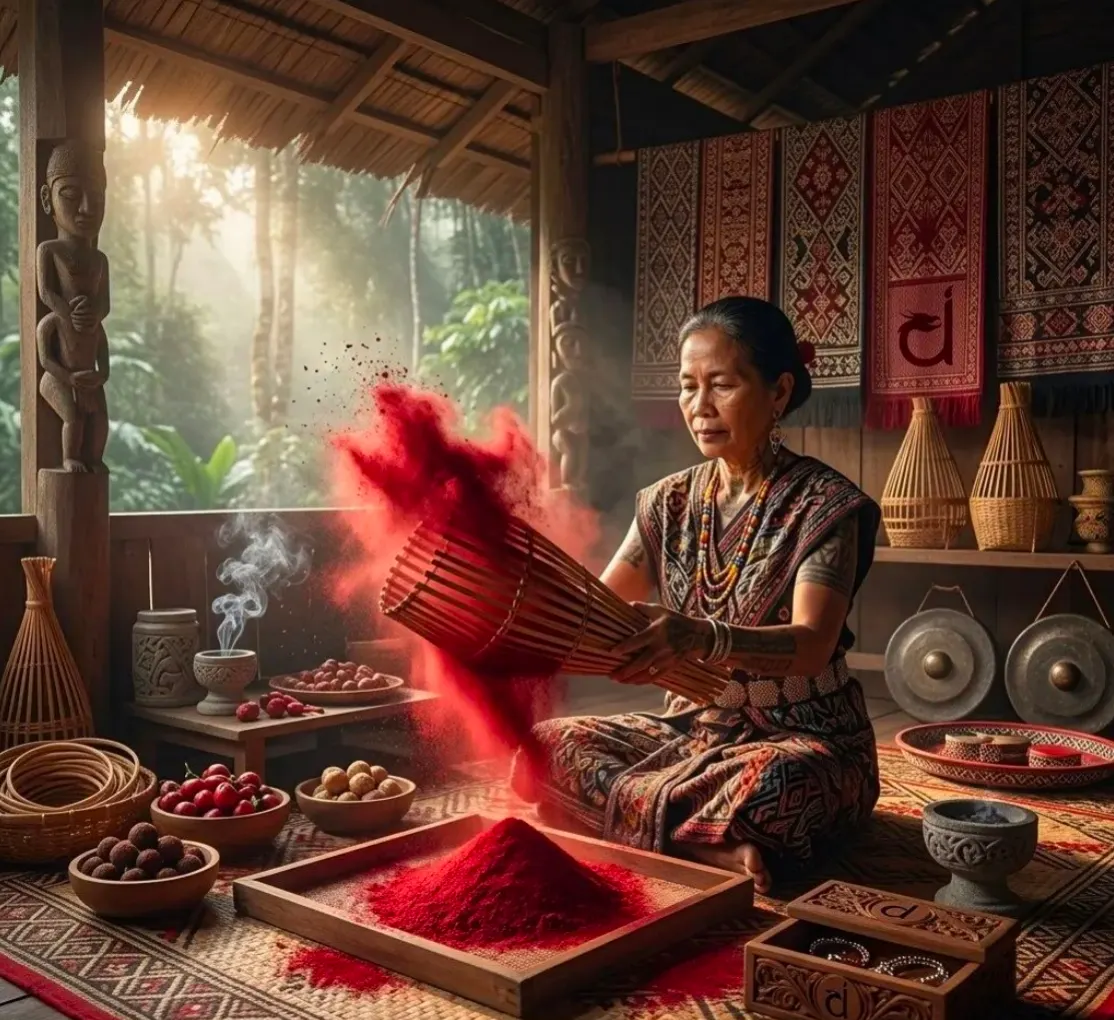
In Dayak culture, perhaps the most visually striking use of dragon's blood is as a natural pigment in traditional weaving and bamboo-rattan craftsmanship. The Dayak are world-renowned for their exquisite woven goods — rattan baskets (ambung), mats, and rattan textiles — all coloured with natural dyes extracted from forest plants.
Within Dayak craft traditions, red carries special cultural weight. The textile documentation organisation Threads of Life records that the distinctive red on traditional Dayak baskets is produced by boiling the emulsion from dragon's blood fruits and rubbing it repeatedly onto the outer surface of uncut bamboo strips and rattan. This is not a secondary use of the resin — it is the core method by which the Dayak achieve that particular cultural colour, a practice sustained across generations within their material culture.
When a Dayak craftsperson dyes a basket red with dragon's blood, they are not simply colouring rattan. They are embedding the substance of the forest into an object that may be used in ceremony, offered as a gift, or presented at a wedding or funeral.
In that moment, the resin carries cultural meaning — a colour that belongs to the forest, and to those who belong to the forest.
⊙ An Animist View of the Forest
The Dayak relationship with nature is fundamentally animist: the forest is not a resource waiting to be exploited, but a living community composed of spirits, ancestors, and other beings. To live well within this community, humans must learn to negotiate with it. Dayak elders are living carriers of ecological knowledge — which trees harbor spirits, which areas require permission before entry, which plants must be handled with care.
Dragon's blood — a resin that "bleeds" from the fruit of a climbing rattan — naturally carries powerful symbolic resonance within an animist worldview. That deep crimson is the color of blood, of life force, of vital energy, and that is no accident. In Dayak tradition, red pigments hold protective and ritual significance. Applying dragon's blood red to a ceremonial object is never an arbitrary choice — it places that object within a symbolic context that a Dayak community can read at a glance.
This layer of meaning — the spiritual weight behind the color red — is completely invisible to the international commodity market.
A buyer holding a kilogram of dragon's blood powder in their hands has no way of knowing that this is the very same substance a Central Kalimantan elder may be, at that very moment, applying to a ritual object with very specific intentions.
CHAPTER 03
What the Forest Teaches Us
Traditional Harvesting Knowledge Is Quality Itself
For today's buyers and traders, the most practical takeaway from indigenous dragon's blood resin knowledge is this:
① Timing
Indigenous communities across Sumatra and Kalimantan understand that dragon's blood resin must be harvested at a specific stage of fruit maturity. Harvest too early, and the resin layer on the fruit is thin and underdeveloped. Harvest too late, and the fruit is overripe, the resin structure already degraded.
This knowledge isn't written in any technical manual — it lives in hands and eyes trained over lifetimes, in the instincts passed down through generations of harvesting families.
A study on dragon's blood resin extraction at varying levels of seed maturity confirmed what indigenous communities have long known: maturity at the time of harvest is the single most important factor determining resin yield and quality (Bambang W., 2010, ITTO-Philippines-ASEAN Rattan Research Project). Traditional communities arrived at this understanding through centuries of observation; modern science is only now confirming it through controlled experiments.
② Extraction Methods
The SAD community's traditional wet pounding method — beating fresh fruit to release the outer resin layer — is distinct from both the "basket shaking method" used by Sumatran village processors and industrial solvent extraction. Each method produces different yields and different quality profiles.
Research from Bireuen Regency in Aceh Province, conducted at the University of Malikussaleh (Saifuddin et al., 2017), documented the region as a centre of traditional wet extraction, noting that the maceration method used by local community processors was later studied as a benchmark for modern industrial improvements.
The point isn't whether traditional methods are "primitive" — they never were. They were optimized for everything the forest could give, and refined for the product that buyers at the oldest end of the trade chain actually wanted: clean, high-resin-content, deep-red material that could be verified by eye, by nose, and by the simplest melting-point test.
③ A Vanishing Advantage
The loss of this knowledge layer has very real consequences. Researcher Yana Sumarna of the Forest and Nature Conservation Research Centre in Bogor documented a troubling set of data on collapsing per-harvester yields.
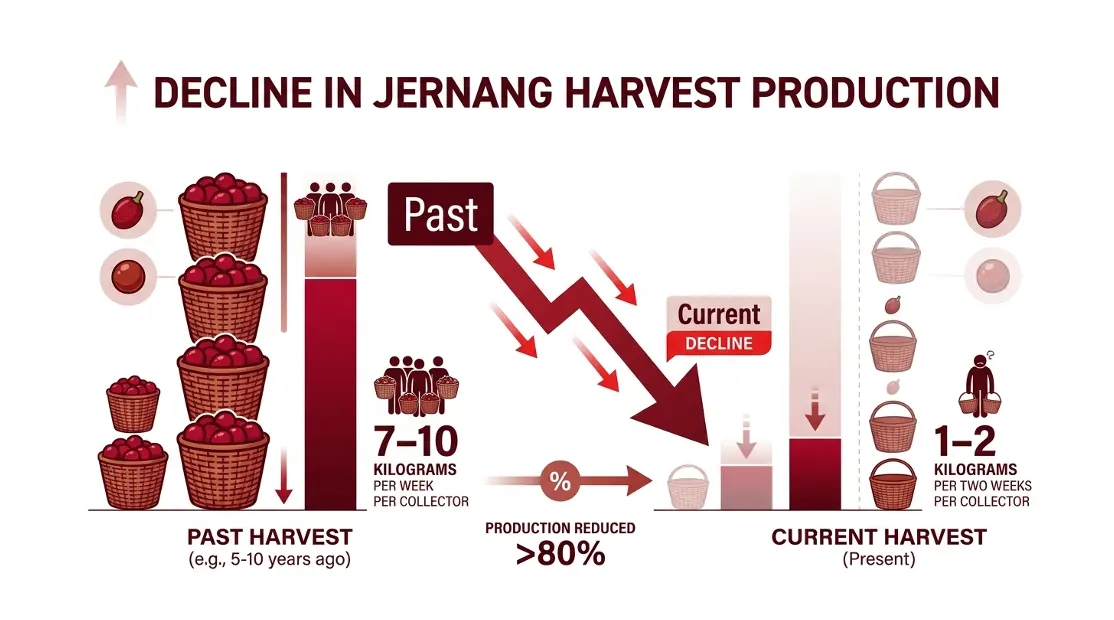
This yield collapse is not solely the result of declining wild populations. It is equally the result of deteriorating harvesting practices: harvesters who, in order to quickly reach the fruit at the top, cut down the entire rattan plant — permanently destroying a resin-producing organism.
This shortcut approach — practiced by harvesters without traditional community knowledge, without any cultural reason to protect the plant — has contributed significantly to the decline.
Traditional communities with harvesting knowledge never cut down the plant. They climb, or wait for naturally fallen fruit, or work within seasonal cycles that allow the plant to recover. This restraint is cultural. It is taught. And it is precisely the kind of knowledge that disappears once communities are displaced, young people leave for cities, or external economic pressures make long-term thinking impossible.
CHAPTER 04
Aceh: Where Culture MeetsExceptional Quality
In a previous article, we noted that Aceh's forest environment produces resin classified as "excellent" — due to its exceptionally high dracorhodin content. This classification was confirmed through private correspondence with F. Ismullah (2018) and documented in IOP research literature (Azwir et al., 2020).
But that earlier framework left one question unanswered: Why does Aceh produce such outstanding dragon's blood resin?
From an ecological standpoint, the answer involves soil composition and forest integrity. But the cultural answer matters just as much.
Aceh's interior is home to several distinct ethnic groups — the Gayo (in Central and East Aceh), the Alas (Southeast Aceh), the Tamiang, and Acehnese forest farmers — many of whom have incorporated dragon's blood resin harvesting into their traditional livelihood systems. These communities harvest within forest territories they know intimately. They know which valleys, which elevations, which water courses produce the heaviest-fruiting dragon's blood rattan.
This kind of generational territorial knowledge is the real reason Aceh's wild dragon's blood resin consistently maintains its premium quality.
When a supplier offers you "Aceh-origin" dragon's blood, they're not just giving you a geographic label — they're giving you the output of an entire layered knowledge system.
CHAPTER 05
Five Things Buyers and TradersShould Know
The cultural and traditional dimension of dragon's blood resin has direct, practical implications for sourcing.
Traceability Matters More Than a "Geographic Label"
"From Sumatra" is not enough. Aceh and Jambi produce the highest-quality wild dragon's blood resin; within those two provinces, whether traditional community harvesters are involved — the SAD communities of Jambi, the community farmers of Aceh's Gayo highlands — is itself an indicator of quality, sustainability, and authentic origin.
The Best Dragon's Blood Resin Comes from Plants That Weren't Cut Down
Traditional harvesting communities do not destroy resin-producing plants. The "cut-and-fell" approach driven by industrial pressure may maximize yield in a single operation, but it permanently eliminates that plant's future productive capacity. Buyers willing to pay for quality should be asking: how does your supplier obtain these fruits?
Species Matter — Not All Local Names Refer to the Same Plant
SAD communities distinguish between jernang kuau and jernang kelukup. That distinction reflects real quality differences. Buyers and traders who engage directly with traditional community suppliers can learn to identify by species and grade — something commodity middlemen can never do.
China Remains the Primary End Market — and Is Highly Quality-Sensitive
Data from Indonesian trade forums indicates that Chinese buyers purchase between 500 and 3,000 kilograms per month, with requirements consistently specified as Grade Super or Grade A, with specific benchmarks for dracorhodin content and purity. SNI 8663:2018 provides the measurement framework; traditional harvesting methods remain the most reliable path to consistently achieving top-tier grades.
Supply Chains with Community Roots Are More Resilient
Because dragon's blood resin is a non-timber forest product (NTFP) with no commercial-scale cultivation to date, supply stability depends entirely on the continued existence of wild forests. The communities that have managed and protected jernang populations for generations are the most reliable long-term suppliers. Communities under economic stress, or areas where deforestation has already occurred — no matter how their products are packaged — represent increasingly unstable sources.
EPILOGUE
The Resin Remembers Its People
Nearly two thousand years ago, when Pliny the Elder wrote of "Indian cinnabar," he was already describing a commodity that had travelled far from its source. By the time it reached Rome, its origins had been mythologized into battles between dragons and elephants, cosmic legends of spilled blood. The real forests, the real people, the real hands that gathered the resin — to Rome's markets, they were invisible.
They should not
be invisible to us.
The Suku Anak Dalam, the Talang Mamak, the Suku Kubu, the Melayu Tua, the Dayak peoples of Kalimantan — they are not background characters in the story of dragon's blood resin. They are the story's original authors.
The quality standards that buyers rely on, the extraction methods that researchers reference, the species distinctions that define product grades — all of these can be traced back to the deep forest, to generation after generation of people, to knowledge systems developed by communities that regarded the rattan vine as a neighbor rather than a commodity.
Understanding this history,
won't make trade more complicated.
It will make trade
clearer.
END · THE RED RESIN