
When you step into the tropical rainforests of Southeast Asia, you can feel the air fills with the scent of damp earth and decaying leaves, punctuated by distant birdsong and the murmur of streams. Hidden within this seemingly ordinary green world lives a plant that “bleeds” — when wounded, it oozes a deep crimson resin, as if the earth itself were weeping.
This is Dragon’s Blood, a remarkable red resin that humans have used for over a millennium. Ancient Romans used it as pigment, Italian luthiers mixed it into violin varnish, Eastern healers prescribed it as medicine, and modern brands now add it to skincare products.
What Exactly Is This “Bleeding Tree”?
When most people hear “dragon’s blood,” they think of the iconic Dragon Blood Tree. But the Indonesian dragon’s blood we’re discussing here is an entirely different species.
Its scientific name is Daemonorops draco Bl., a climbing palm in the family Arecaceae. Unlike the towering Dragon Blood Tree, this plant grows as a vine, winding its way up the trunks of rainforest giants. Its fruit is covered in thin red scales that secrete a vivid crimson resin — dragon’s blood in its most primal form.
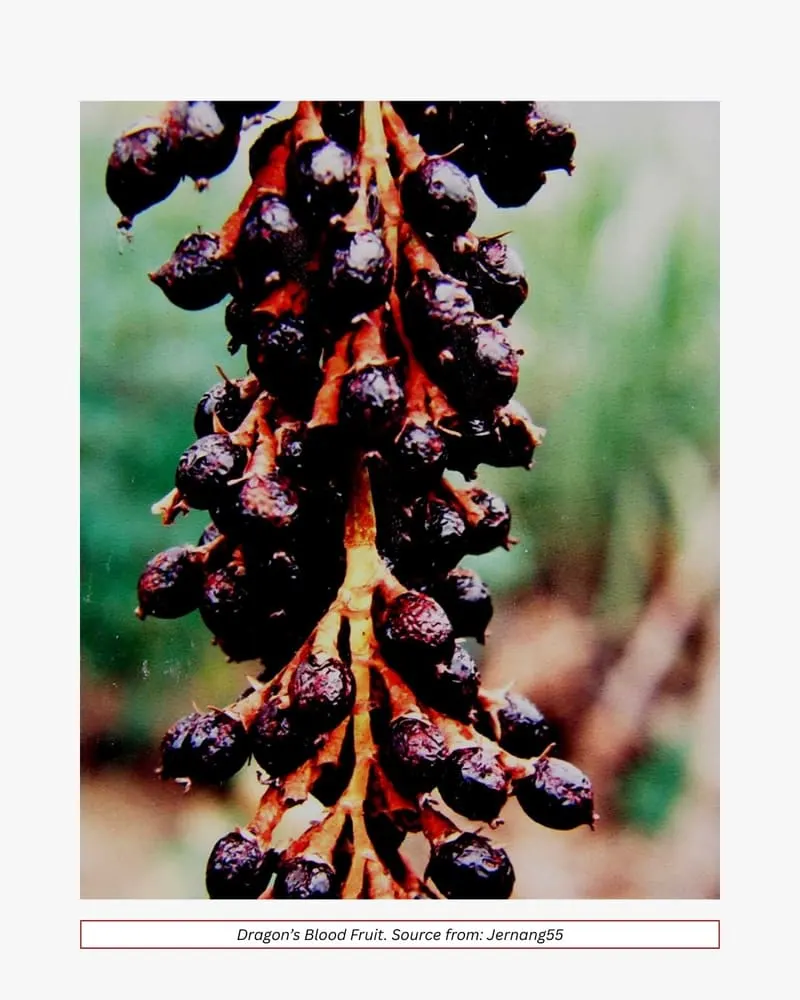
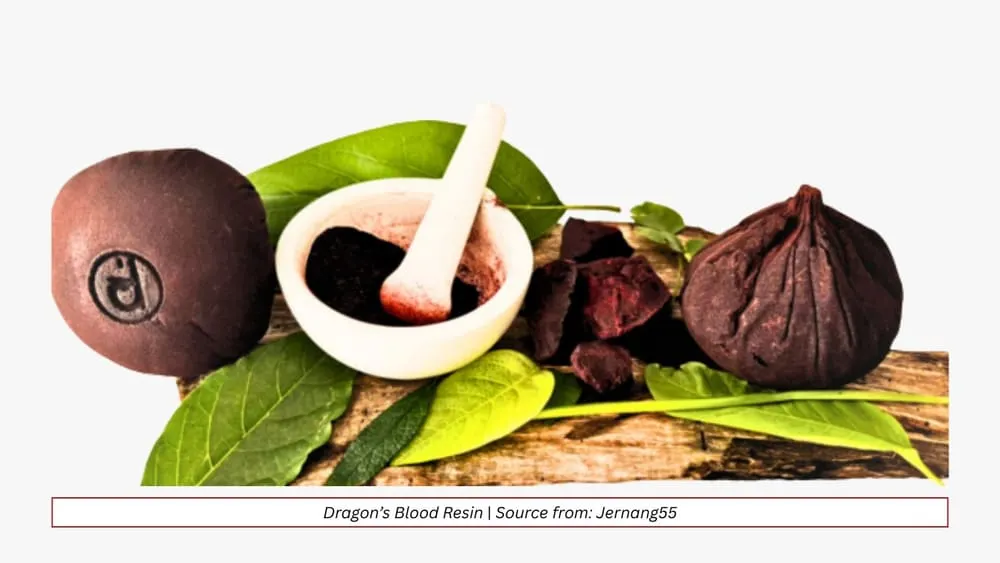
The resin has a dark, blood-red color with a hard texture. It has a faint, pleasant fragrance and a mild, slightly astringent taste. It grows primarily in the virgin rainforests of Sumatra and Kalimantan (Borneo) in Indonesia, where the hot, humid climate provides the perfect habitat.
Note: Daemonorops draco Bl. (Arecaceae/palm family) is NOT the same as Dragon’s Blood tree resin (Dracaena). The former is a climbing palm whose fruit scales produce the resin; the latter is a tree whose wounded trunk exudes resin. Though both produce red resin, they belong to different families with distinct chemical compositions.
An Ancient Legend of "Dragon's Blood"
The name "Dragon's Blood" traces back nearly two thousand years to a dramatic ancient legend.
According to the legend, a dragon and an elephant engaged in a fierce battle. The dragon, seeking to escape the heat, craved the elephant's blood. In the struggle, the elephant crushed the dragon beneath its weight, and their mingled blood soaked into the earth. From this blood-soaked ground, a plant emerged that, when wounded, bled a crimson resin — the very substance we now call "Dragon's Blood."
This legend originated in ancient Rome and was recorded by Pliny the Elder in his monumental work "Naturalis Historia" (Book VIII, Chapter 11). Pliny described how the dragon, driven by its desire for elephant blood to escape the heat, would lie in wait for elephants near their watering holes. When the elephant approached, the dragon would wrap itself around the elephant's trunk, attempting to drink its blood. The elephant, in turn, would crush the dragon against trees or rocks, and their combined blood would seep into the ground.
From this mingled blood, a red pigment emerged, which the Romans called "Indian cinnabar." This is the origin of the name "Dragon's Blood" — a name that has persisted for nearly two millennia.
In 1549, the German botanist Valerius Cordus clarified that "Dragon's Blood" is actually a natural red resin from Dracaena trees on the Canary Islands. However, the name had already traveled far and wide, eventually reaching Southeast Asia, where it became associated with the Indonesian Daemonorops resin — the very substance we celebrate today.
Original Source: Pliny the Elder, Naturalis Historia, Book VIII, Chapter 11: "In Quibus Locis Sint Elephanti; Antipathia Elephanti et Draconis." The English translation by John Bostock (1855) is available through the Perseus Digital Library.
A Red Remedy Used by Humans for Two Thousand Years
Dragon's Blood has been used for health purposes in both Eastern and Western traditions for nearly two millennia.
In the East, the Tang Dynasty's official pharmacopoeia "Xinxiu Bencao" (659 AD) documented its medicinal properties. Later, Li Shizhen's "Bencao Gangmu" of the Ming Dynasty devoted an entire entry to Dragon's Blood, describing its uses for promoting blood circulation, stopping bleeding, and healing wounds. In the West, ancient Greek and Roman physicians used it for stopping bleeding and healing wounds, recognizing its remarkable therapeutic properties.
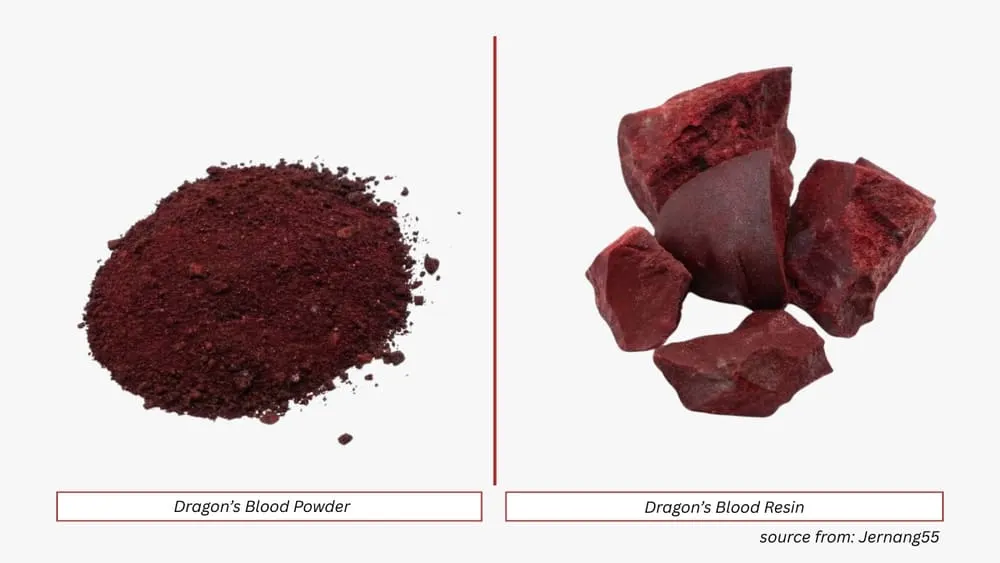
Across cultures and centuries, people have found dragon’s blood particularly useful in three key areas:
Promoting blood circulation — Dragon’s blood helps improve local blood circulation. In Eastern tradition, it has long been used for bruising and swelling from injuries; Western surgeons of earlier centuries also noted similar circulatory benefits.
Stopping bleeding and reducing inflammation — Interestingly, dragon’s blood can both promote blood flow and help stop bleeding, acting as a “dual-action” natural substance. Its anti-inflammatory properties have been recognized by both Eastern and Western traditional medicine.
Accelerating wound healing — Ancient practitioners discovered early on that applying dragon's blood to wounds promotes healing and new tissue growth. This has been preliminarily confirmed by modern laboratory experiments.
From Fruit to Finished Product: How Dragon's Blood Is Made
Many people wonder: how does the red powder coating a palm fruit transform into a hard, dark-red resin block? The process is quite fascinating.
Traditional Standard Processing
According to Chinese pharmaceutical literature, the traditional workflow for producing dragon's blood follows these steps:
1. Collecting ripe Daemonorops draco fruits.
2. Sun-drying them thoroughly.
3. Placing the dried fruits in bamboo baskets with shells and
vigorously shaking them to shatter the brittle red resin coating into
fine powder.
4. Sieving out husks and impurities.
5. Wrapping the red powder in cloth.
6. Placing it in hot water to soften into a lump.
7. Removing and cooling the lump to produce raw dragon's blood.
Traditional Indonesian Methods
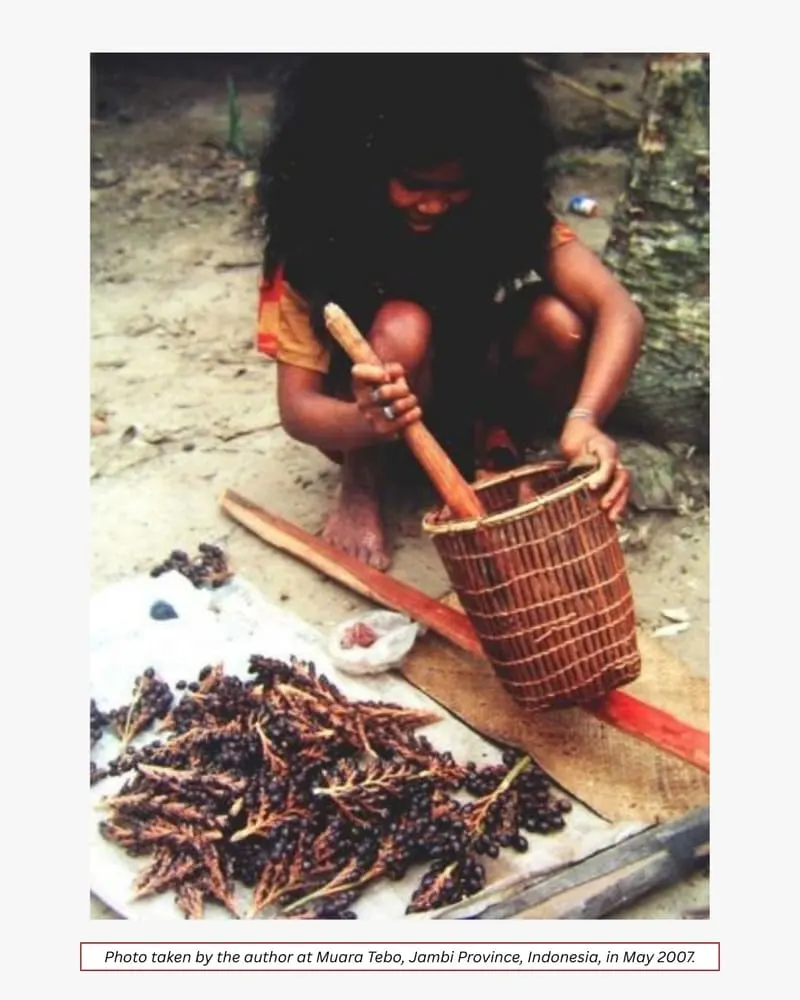
In Sumatra's villages, craftsmen have passed down two extraction methods for generations. The dry extraction method involves placing dried fruits in a woven rattan basket called an "ambung" and shaking vigorously until the red resin crumbles into fine powder. The collected powder naturally hardens within about an hour, sometimes steamed briefly for faster, more uniform solidification. The wet extraction method involves crushing fresh fruits in water, filtering out seeds and skin, then allowing the heavier resin particles to settle. The sediment is sun-dried into solid, deep-red resin blocks.
Modern Industrial Processing
Today's laboratories use more advanced methods, such as soaking fruits in ethanol for 24–72 hours (maceration), achieving resin yields of approximately 73%. The extract is then concentrated using rotary evaporation at around 70°C, followed by oven drying at 60°C to eliminate residual moisture and solvents.
What Does Modern Science Say?
Modern researchers are investigating dragon's blood, identifying primary active compounds like Dracorhodin and Dracorubin. Other compounds include nordracorhodin, nordracorubin, flavanols, and triterpenoid compounds (pimaric acid, isopimaric acid), which exhibit synergistic pharmacological activity.
Recent research highlights promising potential in areas like:
Antioxidant activity — scavenging free radicals, slowing cellular aging.
Anti-inflammatory and analgesic effects — reducing inflammation and pain.
Wound healing promotion — accelerating tissue repair and angiogenesis.
Antibacterial properties — inhibiting Staphylococcus aureus and other pathogens.
A study using zebrafish embryos demonstrated Dracorhodin's ability to stimulate new blood vessel sprouting — a modern scientific confirmation of ancient observations.
More Than Medicine: The Many Lives of Dragon's Blood
Dragon's blood has played diverse roles in human life beyond traditional remedies, from Pliny's era to the present.
Natural Dye and Pigment
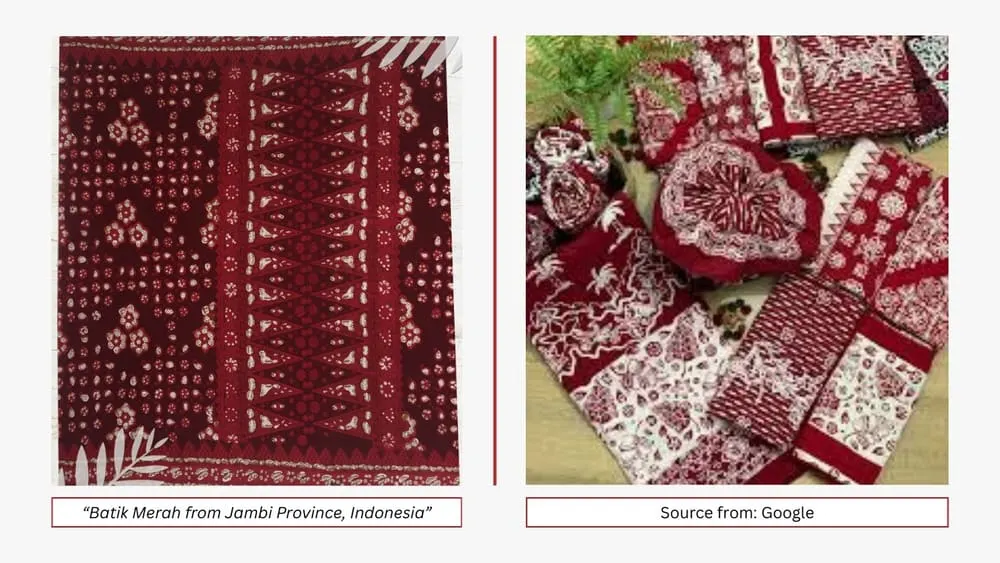
Dragon's blood is prized as a natural dye due to its rich, deep red color. In Indonesia, it is used to color fabrics, paper, and leather, particularly in traditional batik (wax-resist dyeing) for warm red tones. Ancient painters, including Pliny, also used it as a pigment.
Musical Instruments and Fine Furniture
Dragon's blood resin was used by 18th-century Italian violin makers in their varnish formulations. It produced a warm reddish-brown lacquer, giving violins a distinctive luster and protective coating. The same formulation was used for high-end furniture finishing, contributing to the elegant reddish tone in European classical furniture.
Gemstone and Craft Enhancement
In European traditional crafts, dragon's blood resin was used to enhance the color of gemstones and to tint glass and marble red, providing a warmer, more luxurious appearance. It also found application in the printing industry for photo-engraving, where it protected plate surfaces from acid undercutting during etching.
Beauty and Skincare
Dragon's blood has become a star ingredient in modern skincare. Its active compounds offer excellent antioxidant capacity (neutralizing free radicals, slowing skin aging), anti-inflammatory properties (soothing redness and sensitivity), and wound-healing abilities (fading scars, repairing damaged skin). International skincare brands incorporate its extract into anti-aging serums and repair masks, sometimes calling it "nature's Botox." When choosing products, consumers should opt for reputable brands and verify ingredient information.
Incense and Ritual
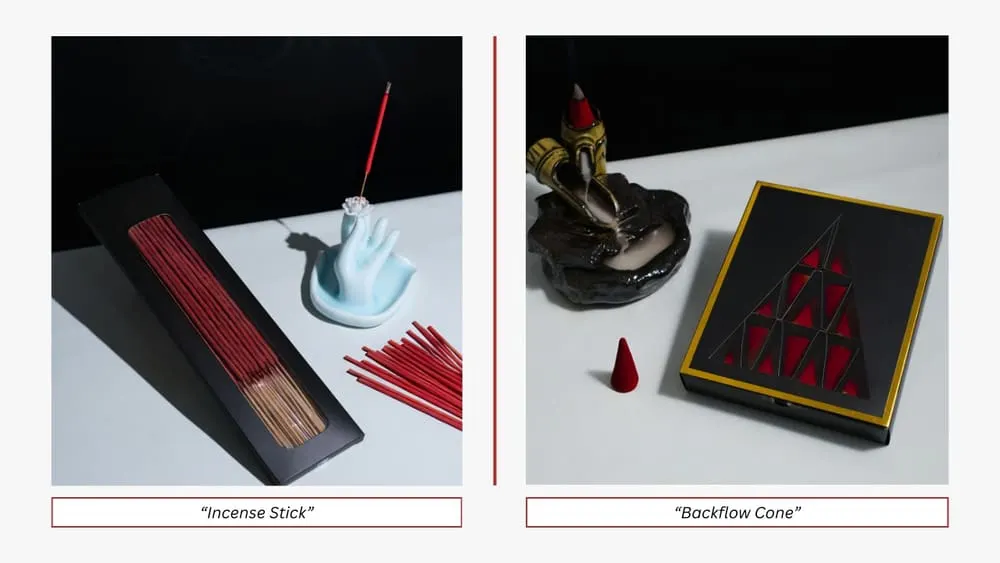
Dragon's blood resin serves as a premium incense in the Middle East and South Asia, releasing a warm, subtly sweet, mildly medicinal fragrance. In various traditional cultures, burning dragon's blood is believed to purify spaces and dispel negative energy, remaining a staple in many natural incense enthusiasts' collections.
Why Is Indonesian Dragon's Blood the Best?
Just as wine has "terroir" and herbs have "dao di" (authentic origin), Indonesian equatorial rainforests provide the ideal environment for Daemonorops draco. Aceh province, in particular, produces premium-grade resin with high Dracorhodin content — the "Bordeaux" of dragon's blood.
The world's dragon's blood supply largely comes from Indonesia and Malaysia's tropical rainforests, used in various applications from European violin workshops to Middle Eastern incense shops and Asian traditional pharmacies.
The world's dragon's blood supply has long depended on Indonesia and Malaysia's tropical rainforests. Whether it ends up in a European violin workshop, a Middle Eastern incense shop, or an Asian traditional pharmacy, the resin very likely comes from the same equatorial forests.
Indonesian Dragon's Blood vs. Dragon Blood Tree Resin: Key Differences
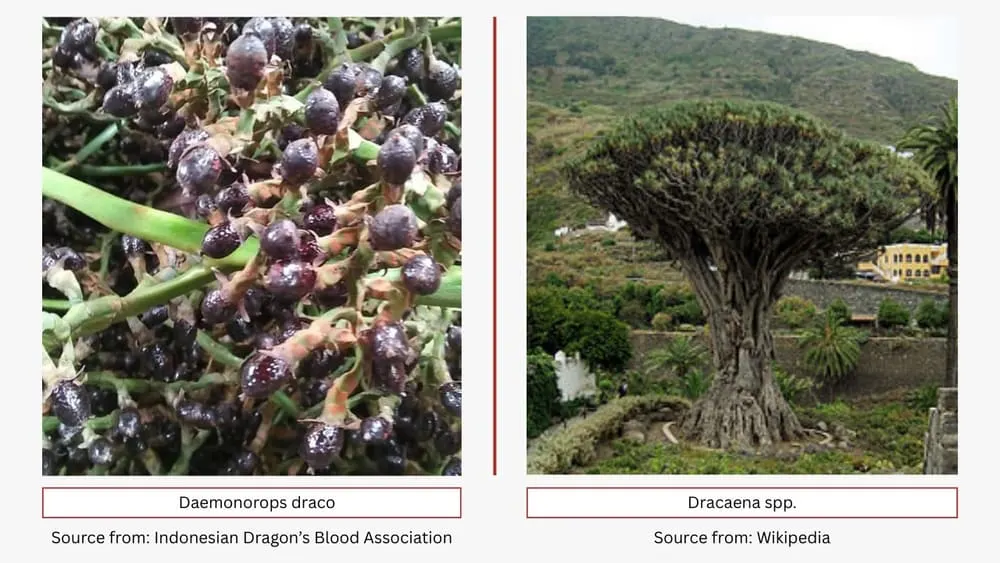
| Category | Indonesian Dragon's Blood | Dragon Blood Tree Resin |
|---|---|---|
| Scientific Name | Daemonorops draco | Dracaena spp. |
| Family | Arecaceae (Palm) | Asparagaceae |
| Distribution | Sumatra, Kalimantan, Indonesia | Yunnan, Guangxi, Hainan, Africa |
| Source Part | Resin from fruit scales | Resin from wounded trunk |
| Key Compounds | Dracorhodin, Dracorubin | Loureirin A, Loureirin B, etc. |
Important Precautions
Dragon's blood is a potent medicinal substance, not a health supplement. Keep these points in mind:
Dosage matters — Dragon's blood has strong bioactivity. Whether taken internally or applied externally, follow instructions or professional guidance for proper dosing.
Caution during pregnancy — Dragon's blood promotes blood circulation, making it best avoided during pregnancy.
Patch test first — Like any new skincare ingredient, try a small amount first and watch for allergic reactions.
Beware of counterfeits — The market is full of fake dragon's blood. A traditional authentication method: place a small amount of powder on white paper and heat it from below. Genuine dragon's blood will melt without leaving an oily stain, and when held up to light, it should appear a vivid, translucent red.
From the rainforests of Sumatra
to workshops and counters around the world,
from Italian master luthiers' workshops
to today's skincare bottles,
this small, dark-red piece of resin
has traveled a very long road.
It carries the warmth of the rainforest,
the artistry of master craftsmen,
and thousands of years of human exploration
of nature and artisan wisdom.